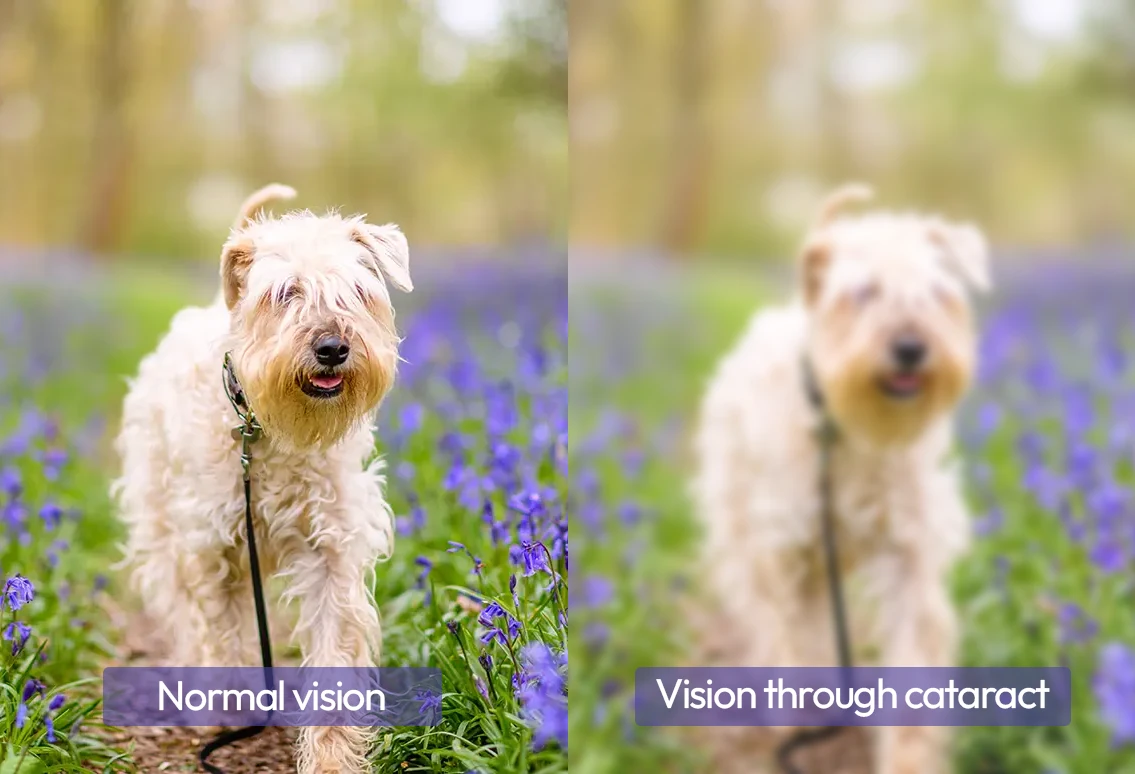
Turn Cloudy Vision into Clear Moments with Cataract Surgery in Singapore
Cataracts can blur printed words, familiar faces, and the road when you’re behind the wheel. At Hesed Eye Specialists, we journey with you from thorough assessment to careful surgery and follow-up, helping you return to daily life with sharp, confident vision.
- Ophthalmologist with 20+ years of Experience
- Insurance and Medisave Claimable
- Transparent Pricing
As Featured In



Meet Your Ophthalmologist—Dr Owen Hee (Cataract Specialist)
Dr Owen read Medicine in London, and basic and specialist ophthalmology training in Singapore and London on scholarship. For over 20 years, he has managed the full spectrum of eye conditions and now performs weekly cataract assessments and lens-replacement surgery, drawing on extensive experience gained at Singapore National Eye Centre, National University Hospital, KK Hospital and Tan Tock Seng Hospital.
His focus is firmly set on helping patients regain clear sight by removing clouded lenses and choosing the most suitable intra-ocular implant, guided by, latest research and technology, cost-effectiveness and evidence-based principles shaped by his training and experience.
Formerly Senior Consultant and Quality Review Officer at the National Healthcare Group Eye Institute, Dr Owen previously advised the Ministry of Health on ophthalmic care policy and taught at both local medical schools, keeping his cataract practice firmly aligned with current standards. He currently serves as Chair of Specialist Interest Group for Ophthalmology at the Gleneagles Hospital Medical Advisory Board.
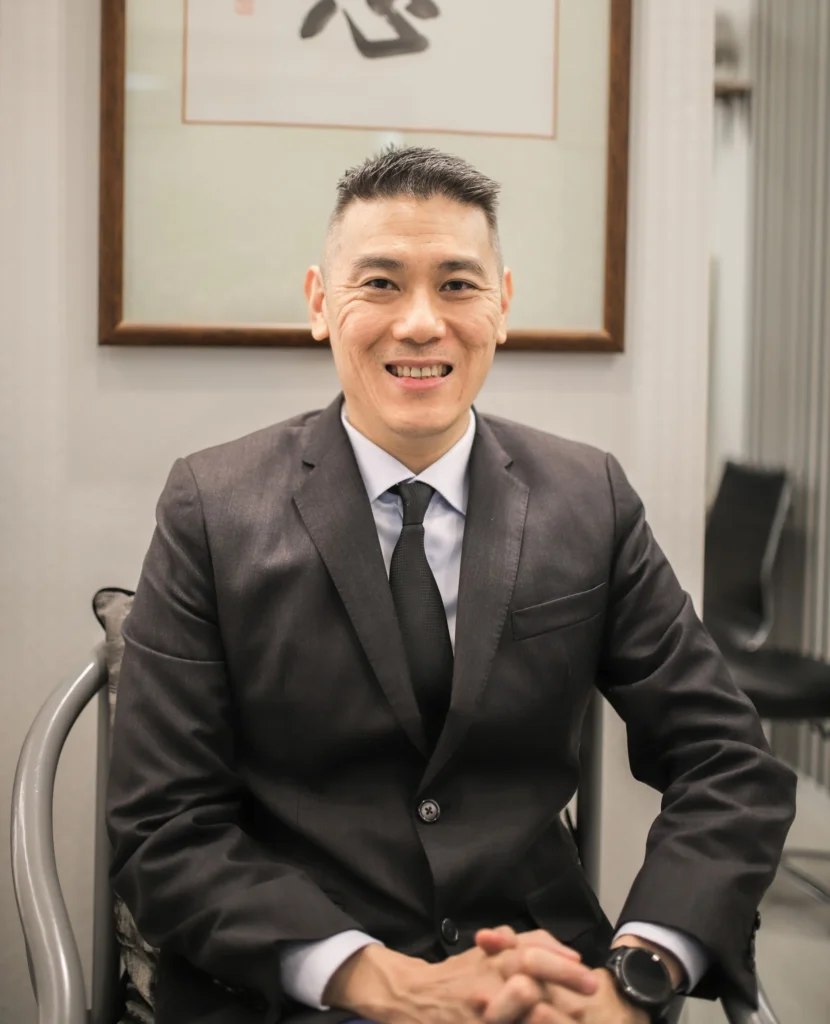
Dr Owen Hee
MBBS (London),MRCSEd (Opth), FRCSEd (Ophth), FAMS (Ophth)
Dr Owen Hee
MBBS (London),MRCSEd (Opth), FRCSEd (Ophth), FAMS (Ophth)
Is a Cloudy Lens Quietly Dimming Your World?
Cataracts tend to creep in so gradually that many people assume it is “just age”. Although the condition is common, no eyedrops, diet, or eyewear can clear the clouded lens.

Frequent spectacle-power changes, yet nothing ever feels truly in focus

Colours that look faded or yellowed, as though a filter sits over your eyes

Hazy or blurred central vision that seems to veil everything you look at

Needing brighter light for reading or sewing than you once did
Cataracts can be a “happy problem” – with the potential to correct both distance vision and “lao hua”
Cataract Treatment Options
Phacoemulsification Cataract Surgery
Through a micro-incision at the edge of the cornea, an ultrasonic probe breaks up (emulsifies) the cloudy lens. The fragments are then washed away, and a foldable intra-ocular lens (IOL) is inserted to take over the lens’s focusing role. The tiny wound usually seals itself without stitches, and many patients resume light activities the next day.
Femtosecond-Laser–Assisted Cataract Surgery (FLACS)
This approach replaces several manual steps with computer-controlled laser pulses. The laser forms the corneal entry, opens the lens capsule, and softens the cataract before it is removed, and an IOL is placed.
By reducing reliance on a handheld blade, the technique offers consistent incision quality and may lower the ultrasound energy needed during extraction.
Take These 5 Steps to Clearer Sight
Stage 1
Consultation & Eye Assessment
- Sit down with Dr Owen to discuss your vision changes, daily challenges, and any medical history that might influence treatment.
- Undergo a comprehensive eye examination, including visual-acuity testing, microscopic lens evaluation, and painless scans to map eye shape and lens thickness.

Stage 2
Personalised Surgery Plan
- Compare lens choices and decide which aligns best with your lifestyle.
- Receive a detailed explanation of expected outcomes, costs, and follow-up visits, so nothing is left uncertain.
Stage 3
Scheduling & Preparation
- Choose a convenient surgery date and time.
- Follow a simple checklist covering pre-op eye drops, any medication you may need to stop taking temporarily, fasting instructions (if sedation is planned), and what to bring on the day of the procedure.
Stage 4
Day of Surgery
- Dr Owen meets you beforehand to answer last-minute questions and confirm the chosen lens.
- Local anaesthetic numbs the eye to keep you comfortable while the procedure is carried out. Your family can wait in a nearby lounge.
- Relax in a recovery bay for a short observation period before heading home.
Stage 5
Recovery & Clear-Vision Check-Ups
- Most patients return to light activities the next day, but you should follow the individual guidance Dr Owen provides.
- Take prescribed anti-inflammatory and antibiotic drops as directed.
- Attend follow-up appointments to confirm healing and fine-tune any new glasses prescription if needed.
Why Choose Hesed Eye Specialists
Over 20 Years of Experience
Dr Owen served as a Senior Consultant at the National Healthcare Group Eye Institute and as a part-time Consultant at Singapore’s Ministry of Health, where he oversaw safety and quality standards. He currently serves as Chair of Specialist Interest Group for Ophthalmology at the Gleneagles Hospital Medical Advisory Board.
Genuine Empathy For All Patients
We listen to your concerns and use them to tailor a treatment that best suits your lifestyle, vision goals, and comfort level.
Expertise and Equipment
Our clinic invests in the techniques and technology required for accurate diagnosis and effective treatment.
Care Guided by Current Research
Your management plan is grounded in peer-reviewed studies and clinical guidelines, ensuring each step is justified and transparent.
Transparent Pricing & Payment Options
Consultation & Initial Tests
| Item | What it covers | Fee (before GST) |
| First consultation | Cost depends on complexity and length of consultation. | $150–$220 |
| Comprehensive eye assessment | Consultation, in addition to:
| $300–$350 |
MOH Fee Benchmarks & Medisave Claimable
| Procedure | MOH Code | Surgeon Fee Range (SGD) | Medisave Claimable (SGD) |
| YAG laser capsulotomy | SL815/1C | $1,100 – $1,800 | $490 |
| Cataract extraction with IOL (one eye) | SL808L/ SL809L/ 4A | $2,900 – $4,400 | $3,210 |
| Complicated cataract extraction with IOL (capsular tension ring/segment) | SL706L/4C | $3,700 – $5,700 | $3,370 |
| Cataract extraction with IOL and trabeculectomy | SL810L /5A | $4,800 – $7,000 | $3,440 |
Cataract Surgery Under the New Integrated Shield Riders: Does Not Mean High Direct Out-Of-Pocket Payments to You
Whether you need an eye exam, cataract surgery, or treatment for conditions like glaucoma, Integrated Shield Plans (IPs) can help manage costs and provide timely access to care. Many eye conditions should be treated early to prevent permanent vision damage. However, upcoming changes to IP riders in April 2026 may discourage some from seeking care, partly due to confusion around new insurance rules. We’ll explain how these rules impact eye care costs while using Cataract Surgery as an example.
What Are Integrated Shield Plans (IPs) and Riders?
Integrated Shield Plans (IPs) are a type of health insurance that provides additional coverage for hospital stays and surgeries. They consist of two key components:
- Core Plan: Covers hospitalisation and surgical costs at public hospitals
- Riders: Additional benefits that include coverage for private hospital treatment, reduced co-payments, and more extensive outpatient services.
If you plan to undergo eye treatments, like cataract surgery or laser eye surgery, adding a rider can help offset the cost at private clinics or hospitals.
What’s Changing with the New IP Riders?
In December 2025, the Ministry of Health (MOH) announced significant changes to the structure of IP riders to help address rising premiums and improve healthcare affordability. These changes will take effect on April 1, 2026. Here are the key updates that may affect your eye care coverage:
- Deductible Coverage
Under the new riders, the deductible—the portion you need to pay before your insurance kicks in—will no longer be covered by riders. This means this amount will need to come either from your Medisave or directly out-of-pocket. But if you have sufficient Medisave, it will likely cover most if not all of this.
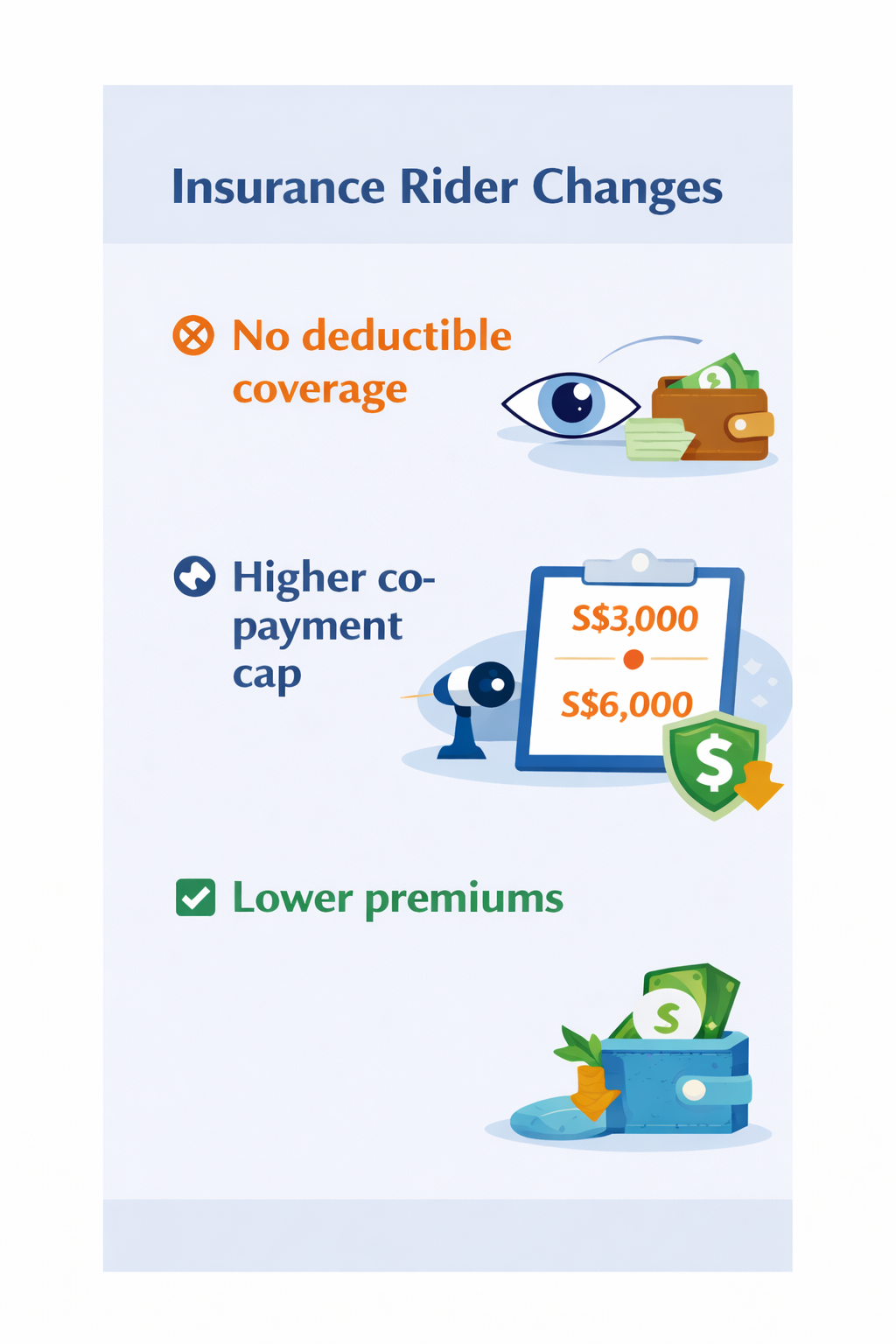
2. Higher Co-Payment Cap
The co-payment cap will rise from S$3,000 to S$6,000. This change means that you may need to pay up to S$6,000 of the bill. However the actual amount of co-payment is often less than S$6,000 because of the smaller bill sizes for eye procedures. This is because with the rider, the co-payment is based on 5% of the insured amount. Again, this may be paid for by MediSave fully or partially.
- Lower Premiums
While the structure of the premiums is changing, a positive outcome is that new riders are expected to be approximately 30% cheaper. This reduction can make eye care treatments more affordable for both new and existing policyholders in the long term.It will help to make things clearer by looking at how these changes impact one of the most frequently performed eye surgeries: Cataract Surgery.
Impact of the New Riders on Cataract Surgery Costs
In a private setting, the cost of cataract surgery typically ranges between S$8,000 to S$12,000 per eye.
Understanding the Financial Impact on Cataract Surgery
With the new Integrated Shield Plan (IP) riders, here’s how the costs of cataract surgery will change for private patients:
- Scenario: Private Hospital/Clinic
- Estimated Cost (per eye): ~S$8,000
- Out-of-Pocket (New Rider): ~S$3,725+ (Deductible + 5% co-payment)
- MediSave Offset: Up to S$3,210 per eye
Expense Breakdown (Example):
First Cataract Surgery
| Expense Item | Old “Full” Rider | New 2026 Rider |
| Total Estimated Cost | $8,000 | $8,000 |
| Deductible | $0 (Waived) | $3,500 (Paid by You) |
| Co-payment | 5% | 5% of remaining bill |
| Total Out-of-Pocket | $400 | $3,500 + $ 225 = $ 3,725 |
| Medisave Claimable | $3,210 | $3,210 |
| Cash Outlay | $0 | $515 |
Second Cataract Surgery (same policy year)
| Expense Item | Old “Full” Rider | New 2026 Rider |
| Total Estimated Cost | $8,000 | $8,000 |
| Deductible | $0 (Waived) | $0 (Not applicable) |
| Co-payment | 5% | 5% |
| Total Out-of-Pocket | $400 | $400 |
| Medisave Claimable | $3,210 | $3,210 |
| Cash Outlay | $0 | $515 |
Key point: The deductible is only payable once per policy year and applies to the first surgery, even if it is not eye-related. Any subsequent surgeries within the same policy year will not incur the deductible again.
Bottom Line: While patients undergoing private cataract surgery may need to plan for a deductible for the first surgery in a policy year, the overall cost structure remains manageable, especially with MediSave support. For many patients, the second surgery within the same year often involves minimal or no additional cash outlay.
What Should You Do Next? And what Hesed Eye Specialists will do for you:
- Consult Your Eye Specialist: do not delay diagnosis
Early detection and diagnosis saves vision. Do not delay getting your eyes checked if there are concerns. - Review Your Coverage
Check your current IP rider and understand what’s covered, especially if you’re planning eye treatments in the future. - At Hesed Eye Specialists we are committed to integrity and transparency:
- We follow MOH Fee Benchmark for surgeon fees for all procedures
- We follow all Insurance Panel rates for the insurance companies we are empanelled on
- We always do pre-procedure financial counselling using the MOH prescribed Form B which provides a fee breakdown of the charges that you are always kept aware of the charges
- We assist our patients in applying in Pre-approval Letter of Guarantees from their insurer so that all the charges for their procedures are pre-approved and there is no financial uncertainty on the costs of their procedures
- Talk to Your Insurer
If you’re uncertain whether your current rider will provide sufficient coverage after the changes, reach out to your insurer for clarification on your options.

Conclusion: Navigating Eye Care and Insurance Coverage
New IP riders don’t necessarily lead to much higher upfront costs for patients at private clinics/hospitals, especially when factoring in lower insurance premiums. The changes are intended not to shift patients toward public healthcare, but to make private insurance and healthcare more sustainable long term, helping keep premiums affordable.
At Hesed Eye Specialists, we are committed to guiding you through your eye care and insurance options. Contact us if you have any questions about treatment or coverage.
Our Insurance Panels
Integrated Shield Plans
We are approved for several Integrated Shield Plans and charge the panel rates set by each insurer.

We arrange a Letter of Guarantee before surgery, so eligible fees are pre-approved and no deposit is required. Follow-up visits within 100 days are included, so your out-of-pocket cost is the same as seeing a panel specialist.
Corporate Insurance
We also partner with selected corporate health plans. Many visits can be processed cash-free, though cover varies. Please contact us in advance so we can confirm your entitlement before the appointment.
Ready to See Life in Full Colour Again?
Trade clouded lenses for crisp, confident sight. Reserve your cataract assessment and start seeing the details you’ve been missing.
Opening Hours
Monday – Friday: 9:00 am – 5:00 pm | Saturday: 9:00 am – 12:30 pm | Sunday & Public Holidays: Closed
Opening Hours
Monday – Friday: 9:00 am – 5:00 pm
Saturday: 9:00 am – 12:30 pm
Sunday & Public Holidays: Closed
Frequently Asked Questions
How soon will I see improvement after cataract surgery?
Most people notice clearer vision the following day, and it usually settles within a week.
How long do the results last?
Once the cloudy lens is cleared it is permanent—cataracts do not return.
Is the procedure painful?
We pride ourselves on ensuring none of our patients experience pain or discomfort during surgery.
What downtime should I expect?
Most can return to light activities the next day, but this may differ from one patient to another. Dr Owen will advise you on when it is safe for you to drive, exercise, or return to work.
Are there side effects or risks?
While all surgeries carry some risk, complications from cataract surgery are rare and usually minor, such as temporary discomfort or inflammation. The more serious but rare complications of cataract surgery are:
- Posterior Capsular Rupture: which occurs in less than 1% of cases and is a highly manageable complication in experienced hands with good outcomes still if managed well.
- Endophthalmitis: A serious infection that can cause blindness but occurs in less than 1 in 3000 cases or less than 0.01% of all cataract surgeries performed.
Is cataract surgery safe?
Cataract surgery boasts a success rate of over 99%, with most patients experiencing significant improvement in vision post-surgery. Most patients can resume normal activities within a few days, with full recovery typically occurring within a few days and rarely over weeks.